How does a submersible level transmitter work? Hydrostatic level measurement explained
DWIN Engineering, , 7 min read
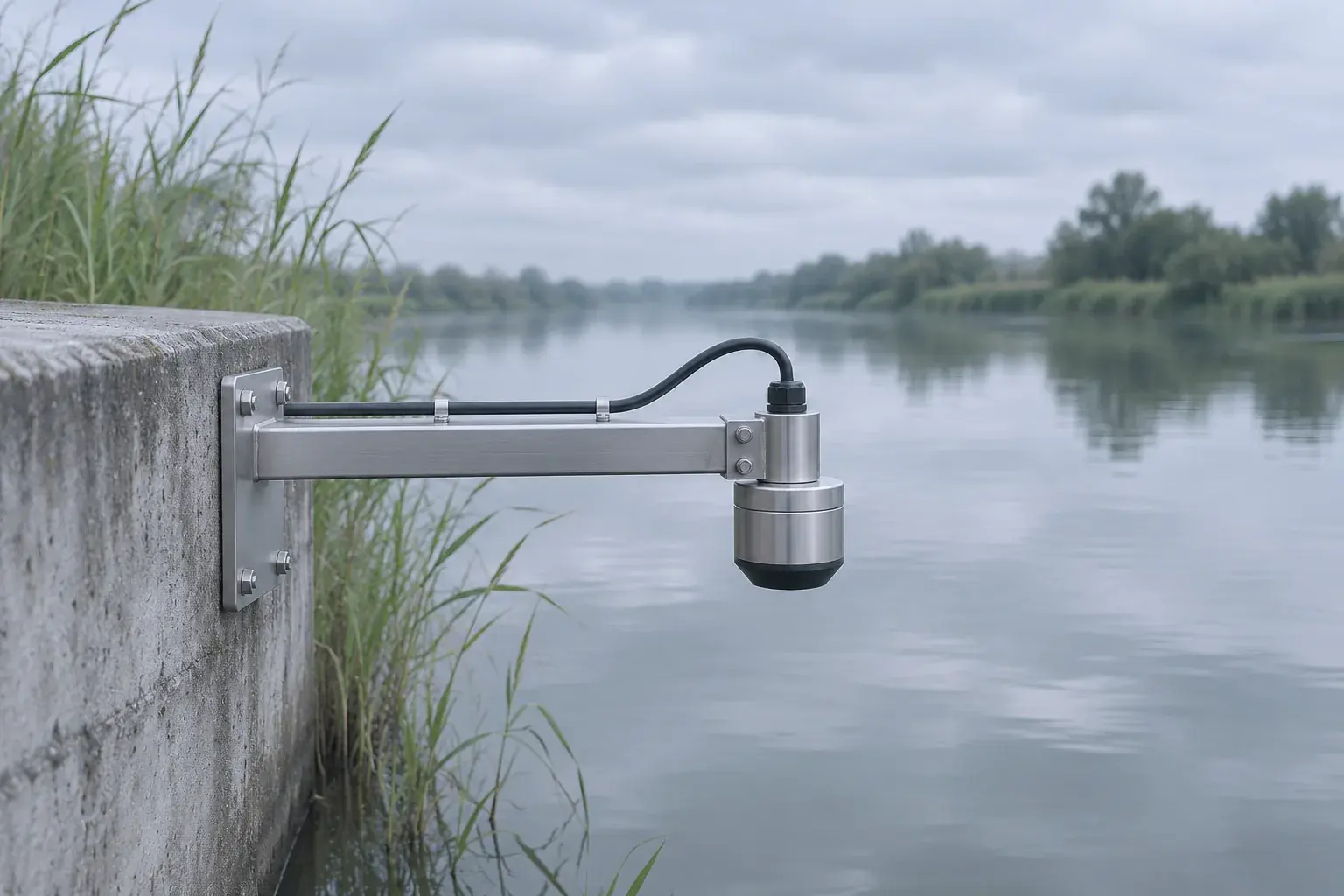
A submersible level transmitter hangs near the bottom of a tank, well or river and measures the pressure of the liquid above it. Because pressure rises with depth (p = ρgh), every meter of water adds about 9.81 kPa, so the transmitter converts that pressure into a level signal such as 4 to 20 mA or RS485.
How does hydrostatic level measurement work?
The pressure at the bottom of a column of liquid depends only on the height of the column, the density of the liquid and gravity: p = ρgh. It does not depend on the shape or width of the tank. A pressure sensor at the bottom therefore measures level directly.
For water at about 1,000 kg/m³ and g = 9.81 m/s², each meter of depth adds 9.81 kPa, close to 0.1 bar. A transmitter that reads 49 kPa above atmosphere is under about 5 m of water. Rearranged, the level is h = p ÷ (ρg).
Because ranges are usually given in meters of water column (mH2O), you rarely do this calculation yourself: a 0 to 10 mH2O transmitter outputs 4 mA with no water above it and 20 mA under 10 m of water.
What is inside a submersible level sensor?
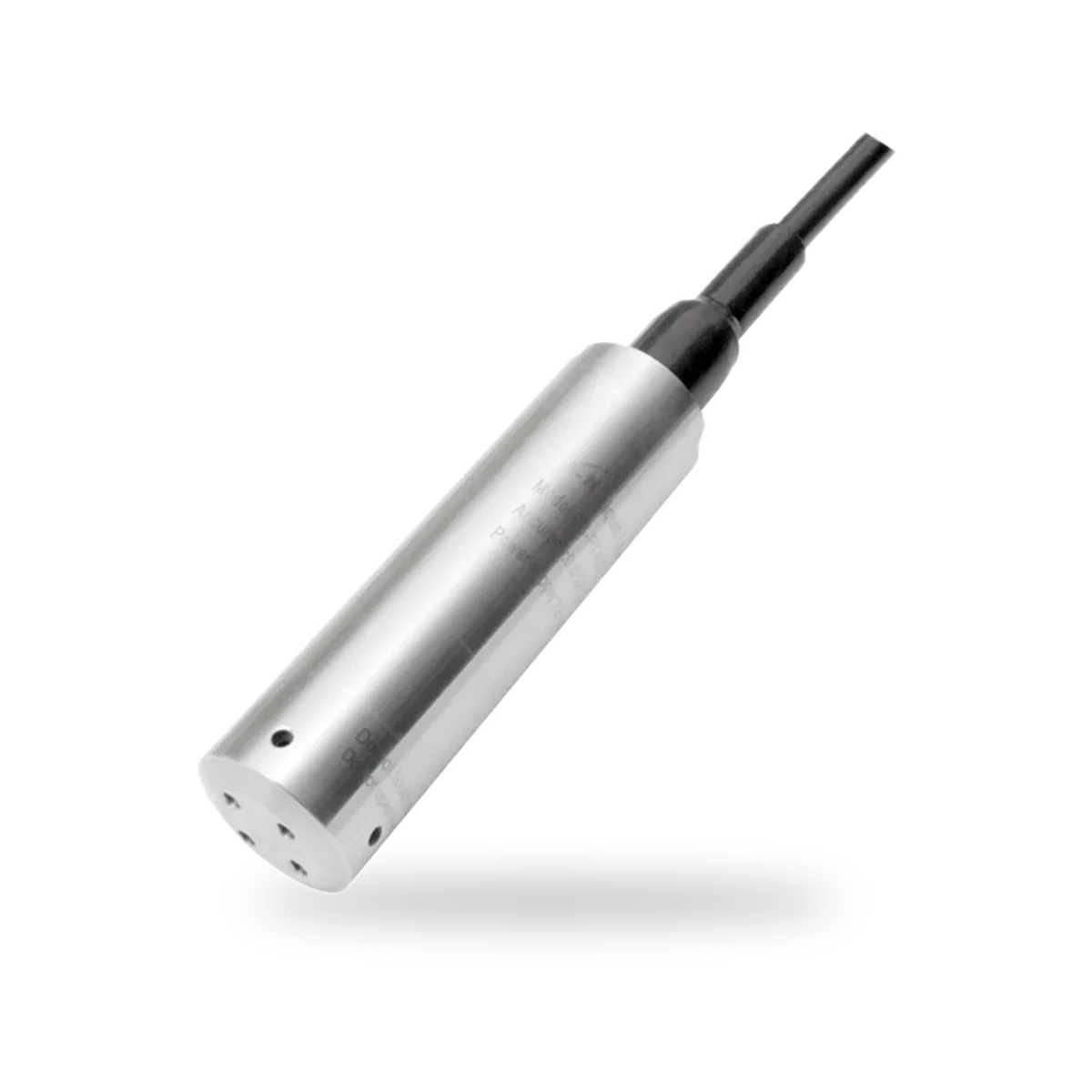
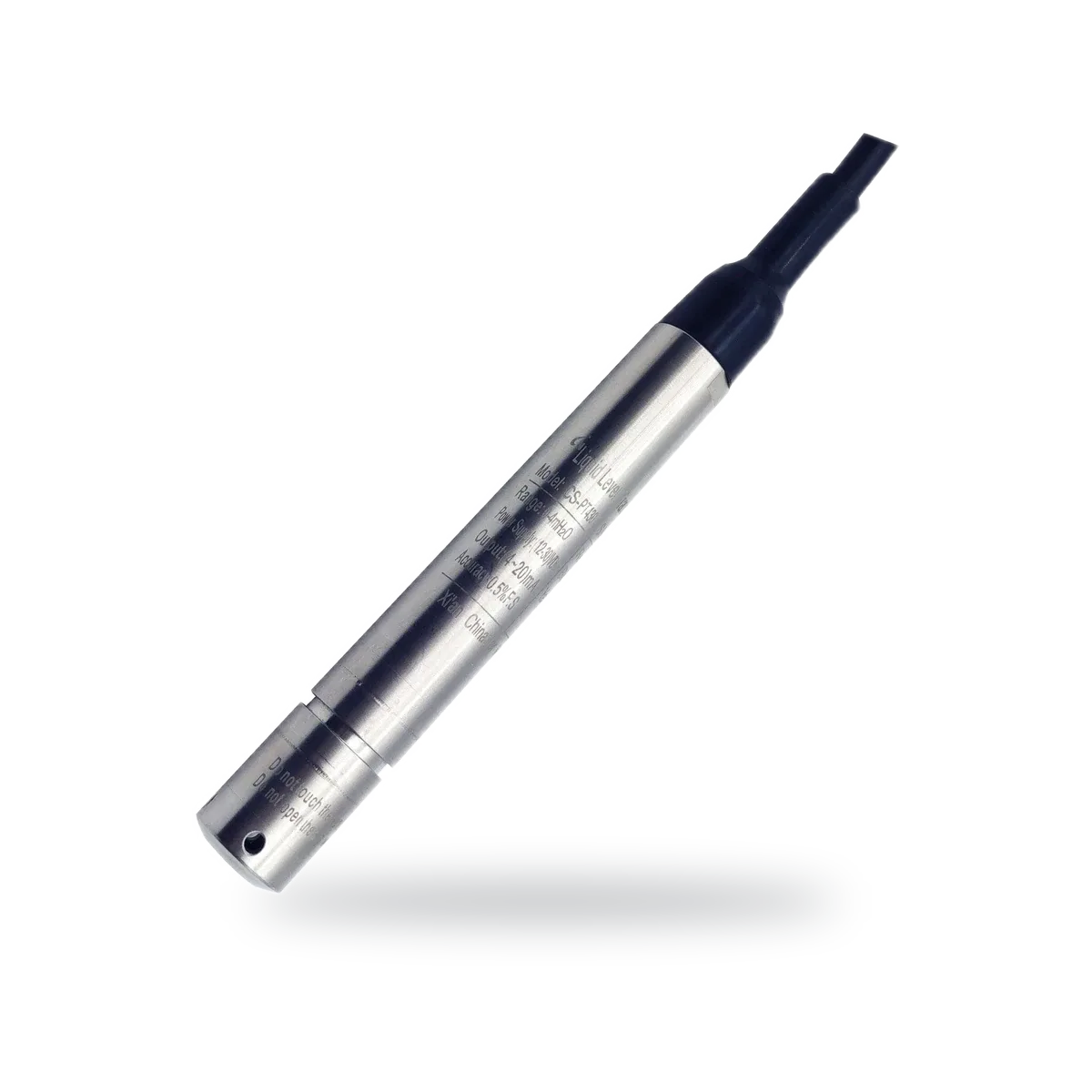
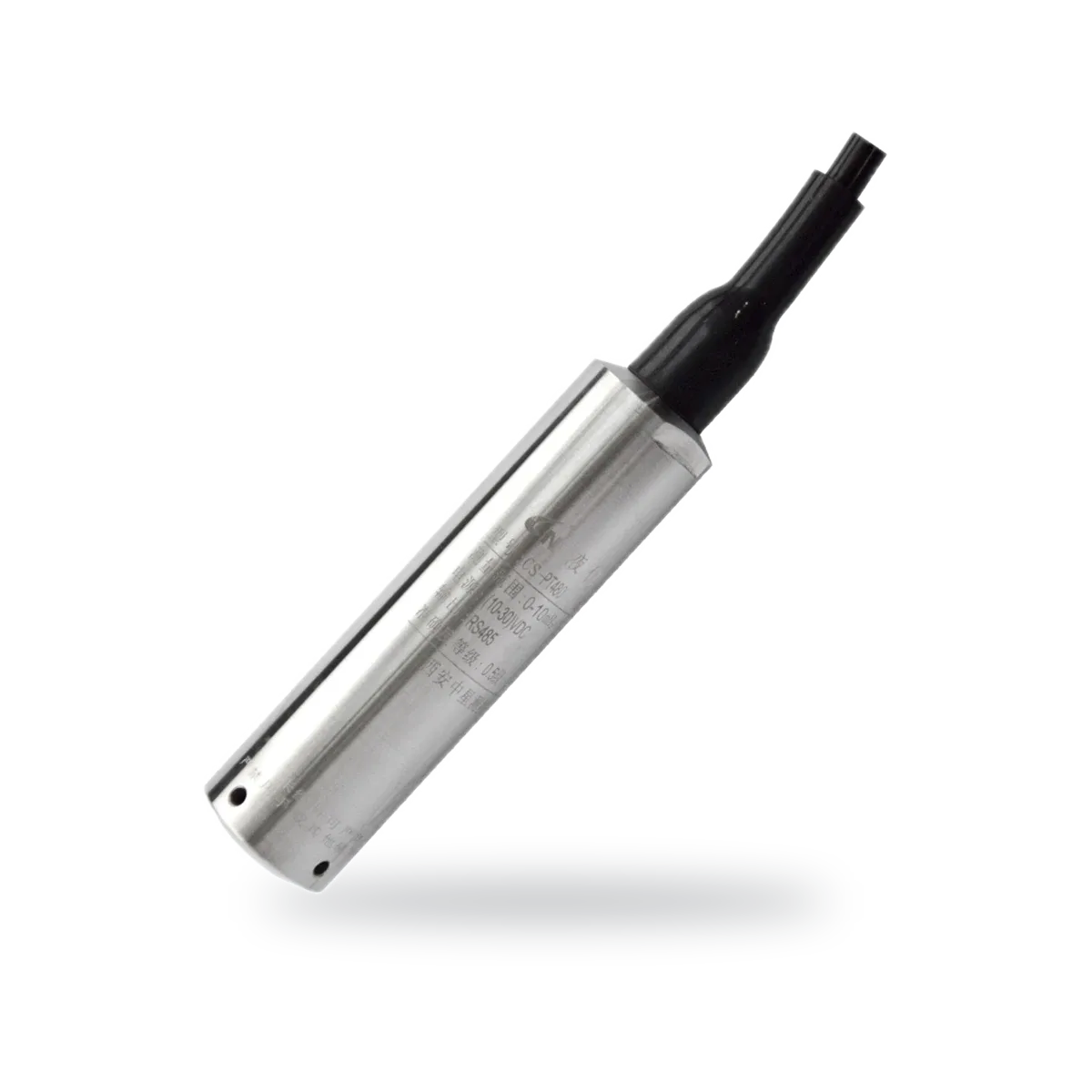
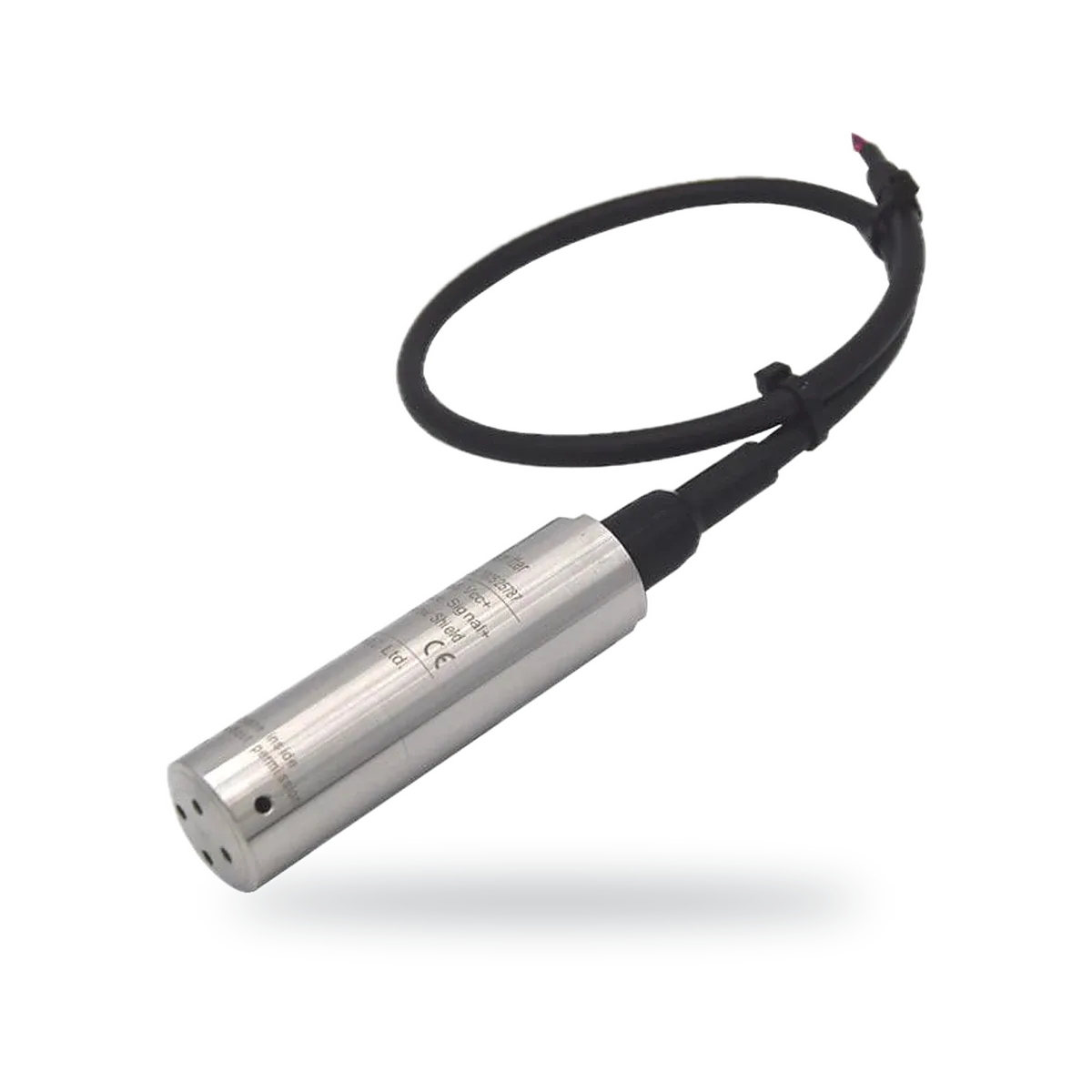
The probe is a sealed stainless steel tube with a pressure sensor at the bottom, behind a diaphragm or a protective nose cap. Electronics in the probe amplify and compensate the signal, and a cable carries power and the output to the surface.
DWIN's submersible probes use either a diffused silicon sensor (CS-PT400, CS-PT430, CS-PT470, CS-PT480) or a silicon resistance sensor (CS-PT471, CS-PT482). The housing is 304 stainless steel by default, with 316L and titanium options on most models, and the cable can be ordered in PE, PUR or FEP to suit the liquid and temperature.
Why do submersible transmitters need a vented cable?
The sensor feels the water pressure plus the air pressure pressing down on the water surface. Air pressure changes with the weather by a few kPa, which is equal to tens of centimeters of water. Left uncorrected, a shallow tank would appear to fill and empty as storms pass.
A gauge (G) transmitter removes this effect by referencing the back of the sensor to atmosphere, normally through a small vent tube that runs inside the cable to the surface. The tube must end in a dry place, such as a junction box, and must not be pinched, cut short or flooded, or the reading will drift.
An absolute (A) transmitter has a sealed reference and measures water plus air pressure. It needs no vent, which suits flooded chambers, but the system must subtract a separate barometric reading to get the level. DWIN's level transmitters are offered in gauge and absolute versions, and the CS-PT482 adds a sealed gauge option.
How does liquid density affect the reading?
A transmitter calibrated in meters of water assumes the density of water. In a lighter liquid the same depth produces less pressure, so the transmitter reads low; in a denser liquid it reads high. Divide the reading by the specific gravity of the liquid to get the real level.
For example, a probe that shows 2.0 mH2O in a liquid with a specific gravity of 0.85 is under 2.0 ÷ 0.85 ≈ 2.35 m of liquid. Some transmitters are calibrated for the actual medium instead: DWIN's CS-PT401, for vessels and tanks, is specified for ranges of 0 to 450 mm up to 0 to 1,200 mm in an oil with a reference density of 0.90 g/cm³.
Temperature changes water density only slightly, by less than 1% between 4 °C and 40 °C, so for most water applications density is treated as constant. Brine, slurry and wastewater with heavy solids need their own density setting.
DWIN submersible and hydrostatic level transmitters
| Model | Range | Accuracy | Output | Notes |
|---|---|---|---|---|
| CS-PT400 | 0–1 to 0–350 mH2O | ±0.25% or ±0.5% FS | 4 to 20 mA, 0.5 to 4.5 V, 0 to 10 V, RS485 | Intrinsically safe, lightning and freeze-proof types |
| CS-PT430 | 0–1 to 0–350 mH2O | ±0.25% or ±0.5% FS | 4 to 20 mA or voltage | 19 mm diameter for narrow boreholes |
| CS-PT470 | 0–1 to 0–350 mH2O | ±0.5% FS | 4 to 20 mA, voltage, RS485 | Embedded pressure port |
| CS-PT471 | 0–3 to 0–50 mH2O | ±1.0% FS | 4 to 20 mA or 0.5 to 4.5 V | General purpose, IP68 |
| CS-PT480 | 0–1 to 0–350 mH2O | ±0.25% or ±0.5% FS | RS485 Modbus | 12 to 30 V or 3.1 to 4.2 V supply |
| CS-PT482 | 3.5 to 350 mH2O | ±0.5% FS | RS485 Modbus | 4.5 to 30 V or 3 to 4.1 V supply |
| CS-WPT400 | 0–3.5 to 0–350 mH2O, −40 to 60 °C | ±0.5% FS (±1% optional) | 4 to 20 mA level and 4 to 20 mA temperature | Platinum temperature sensor |
| CS-PT401 | 0–450 to 0–1,200 mm (oil, 0.90 g/cm³) | ±0.5% FS | 4 to 20 mA | Hirschmann connector, measuring part IP68 |
How to choose the range and output
Choose a range just above the deepest level the probe will see, including floods and overflow. Accuracy is a percentage of full scale, so an oversized range costs resolution: ±0.25% of a 10 m range is ±2.5 cm, while ±0.25% of a 100 m range is ±25 cm.
Two-wire 4 to 20 mA is the default for PLCs and long cables. RS485 Modbus, as on the CS-PT480 and CS-PT482, puts several probes on one cable and suits data loggers. The low-voltage supplies of those two models (3.1 to 4.2 V and 3 to 4.1 V) are meant for battery-powered telemetry.
How to install a submersible level transmitter
- Hang the probe a little above the bottom, so sludge and sediment do not cover the sensor; add that offset to the reading
- Take the weight on a cable hanger or clamp at the top, not on the cable gland
- In rivers, channels and turbulent tanks, fit the probe inside a stilling pipe: a vertical plastic or steel tube with holes that calms the water
- Keep the probe away from pump inlets and fill streams, where flow changes the local pressure
- Terminate the vent tube in a dry, ventilated box and keep the cable end above any possible flood level
- Use surge protection on long outdoor cables; DWIN offers lightning-protected (L) types of the CS-PT400 and CS-PT470
- Check that the cable and seals suit the liquid: PE for clean water, PUR for abrasion, FEP for higher temperatures and chemicals
Submersible vs ultrasonic level sensors
An ultrasonic level sensor mounts above the liquid and times an echo from the surface, so nothing touches the water. Foam, condensation, a blind zone near the sensor face and obstructions in the beam limit it. A submersible transmitter ignores foam, vapor and narrow well casings, and reads to the bottom of the tank, but it sits in the liquid, depends on density and needs cleaning in dirty water.
Choose a submersible transmitter for boreholes, deep wells, reservoirs and tanks with foam or a crowded top. Choose an ultrasonic sensor, such as DWIN's A07 (25 to 800 cm) or A17 (25 to 1,000 cm) well and water-level sensors, where the liquid is dirty or aggressive, or where nothing should enter the water.
Frequently asked questions
What is a hydrostatic level sensor?
A hydrostatic level sensor measures liquid level from the pressure of the liquid column above it, using p = ρgh. In water, each meter of depth adds about 9.81 kPa. Submersible level transmitters are the most common type: a sealed probe hangs near the bottom of a tank, well or river and outputs a level signal.
What is the difference between a level transmitter and a level sensor?
A level sensor is the element that responds to level, such as a pressure cell or an ultrasonic transducer. A level transmitter adds the electronics that convert that response into a standard, calibrated signal, such as 4 to 20 mA, 0 to 10 V or RS485 Modbus, that a PLC or data logger can read. In practice the two terms are often used for the same device.
How deep can a submersible level transmitter go?
The depth limit is the top of the measuring range plus the overload margin. DWIN's CS-PT400, CS-PT430, CS-PT470 and CS-PT480 can be ordered with ranges up to 0 to 350 m of water, and their overload rating is 1.5 times the rated pressure. Choose a range that covers the deepest point including floods, but not much more, because accuracy is a percentage of full scale.
Can a submersible level transmitter measure diesel or oil?
Yes, if the housing, seals and cable are compatible with the liquid and the reading is corrected for density. A probe calibrated in meters of water reads low in lighter liquids: divide the reading by the specific gravity of the liquid to get the real level. Where a tank holds a flammable liquid, use a transmitter with the hazardous-area approval the site requires.
Why does my submersible level sensor reading drift?
The usual causes are a blocked, pinched or wet vent tube on a gauge transmitter, sludge building up over the sensor, and a probe that swings or sits in a flow stream. Absolute transmitters also drift with weather unless a barometric reading is subtracted. Check the vent end, clean the nose cap and fit a stilling pipe if the water moves.
Is a submersible level transmitter better than an ultrasonic sensor?
Neither is better in every case. A submersible transmitter works through foam and vapor and fits narrow boreholes, but it touches the liquid and depends on density. An ultrasonic sensor measures from above without contact, which suits dirty or aggressive liquids, but foam, condensation and its blind zone can disturb it.