How does an electronic pressure switch work? Set point, reset point and outputs
DWIN Engineering, , 7 min read
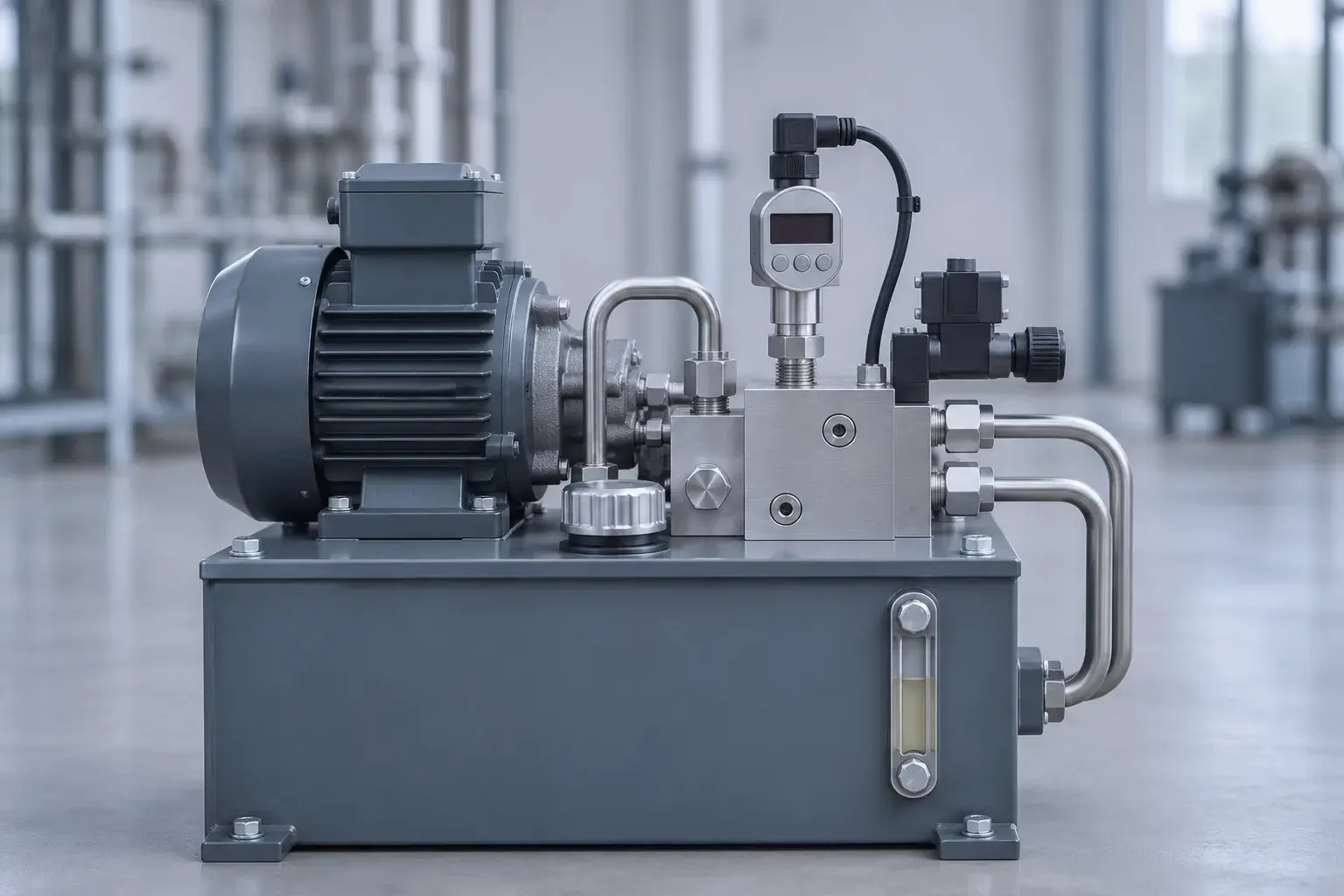
An electronic pressure switch measures pressure with a sensing element, compares the value with a set point you program, and changes the state of a relay or transistor output when the pressure crosses it. It switches back at a separate reset point, and the gap between the two, the hysteresis, stops the output from chattering.
From pressure to a switched output
Inside an electronic pressure switch, the chain has four steps. A sensing element turns pressure into a small electrical signal. An amplifier and converter turn it into a number. A microcontroller compares that number with the set points and applies any delay. An output stage, a relay or a transistor, switches the load.
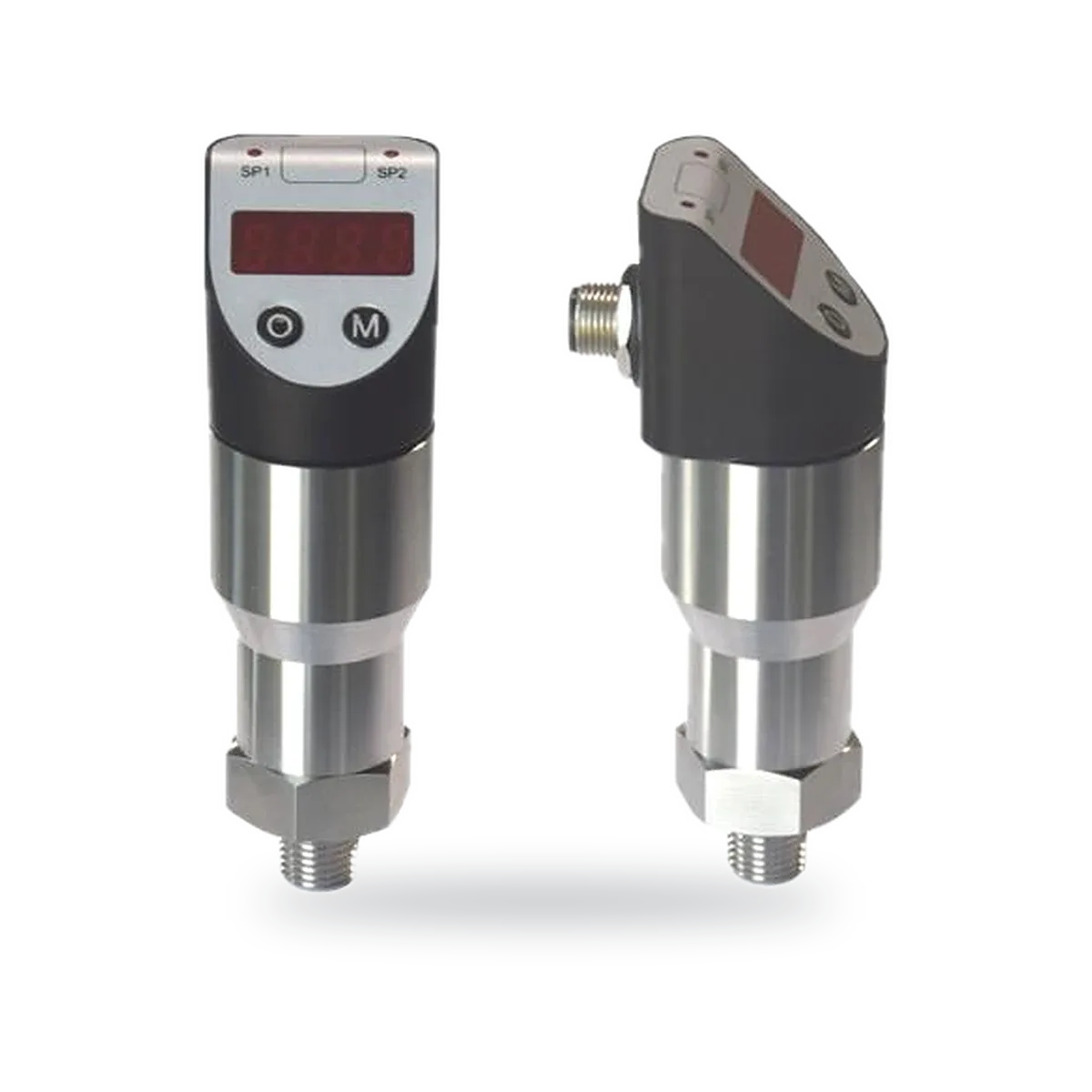
Because the decision is made in software, the switch points can be set anywhere in the range, read on a display and changed without tools. The same measured value can also drive an analog output: DWIN's CS-PT623 has a relay output and a 4 to 20 mA output, with switch points set separately for each.
Mechanical vs electronic pressure switches
| Mechanical | Electronic | |
|---|---|---|
| Sensing | Diaphragm, piston or bourdon tube moving a contact | Pressure sensor and microcontroller |
| Power | None needed to switch | Needs a supply, for example 12 to 30 VDC |
| Setting | Screw and spring, set against a gauge | Entered as a number, often on a display |
| Hysteresis | Fixed or limited adjustment | Set freely as a reset point |
| Repeatability and drift | Spring and contact wear shift the point | No moving parts in the measurement |
| Extras | Usually none | Display, delay, analog output, several outputs |
Set point, reset point and hysteresis
The set point (SP) is the pressure at which the output changes state on rising pressure. The reset point (RP) is the pressure at which it changes back on falling pressure, set below the set point. The difference SP − RP is the hysteresis.
Without hysteresis, pressure that hovers at the limit, or pulsates with each pump stroke, would make the output switch on and off many times a second, wearing out relays and contactors. A wider hysteresis gives calmer switching; a narrower one holds pressure in a tighter band.
Many electronic switches also offer a switch delay and a reset delay: the pressure must stay past the point for a set time before the output changes. A short delay filters out spikes such as water hammer.
Hysteresis mode and window mode
In hysteresis mode, the output changes at the set point and changes back at the reset point. It suits pump and compressor control and simple high or low limits.
In window mode, you set an upper and a lower limit, and the output is active only while pressure is inside the window between them (or only while it is outside, if inverted). It suits checks such as "supply pressure is within its normal band". Not every switch offers window mode, so check the datasheet.
Normally open or normally closed?
On a pressure switch, normally open (NO) means the output is open, or off, below the set point and closes when pressure rises past it. Normally closed (NC) is the reverse: closed below the set point, open above it.
A worked example: a booster pump should start at 3.0 bar and stop at 4.0 bar. Set SP = 4.0 bar and RP = 3.0 bar, and use the NC function to drive the pump contactor. The output is closed and the pump runs until pressure reaches 4.0 bar, then opens. It closes again, restarting the pump, when pressure falls to 3.0 bar.
For safety alarms, choose the function so that a broken wire or lost supply gives the safe state. A high-pressure trip is often wired so the output is closed in normal operation and opens on alarm, because a cut cable then also trips.
Relay, PNP or NPN output?
A relay output is a potential-free contact. It can switch AC or DC loads such as contactors, lamps and small motors directly, and isolates the switch from the load circuit. Relays are slower than transistors and their contacts wear with the number of switching cycles and the load current.
A transistor output switches DC only and has no moving parts, so it is fast and lasts indefinitely within its rating. A PNP output switches the positive supply to the load; an NPN output switches the load to 0 V. PLC inputs are built for one or the other, so match them: PNP is common in Europe and North America, NPN in much Asian machinery.
DWIN electronic pressure switches
| CS-PT623 | CS-PT624 | |
|---|---|---|
| Pressure range | 0–0.07 bar to 0–1,000 bar | 0–2 bar to 0–600 bar |
| Accuracy | ±0.5% FS standard, ±0.25% and ±1% optional | ±0.5% FS |
| Outputs | Relay and 4 to 20 mA | Relay |
| Relay rating | Load ≤1,000 mA | 0.5 A at 120 VAC or 1 A at 24 VDC |
| Supply | 24 VDC (24 ± 5 VDC) | 12 to 30 VDC |
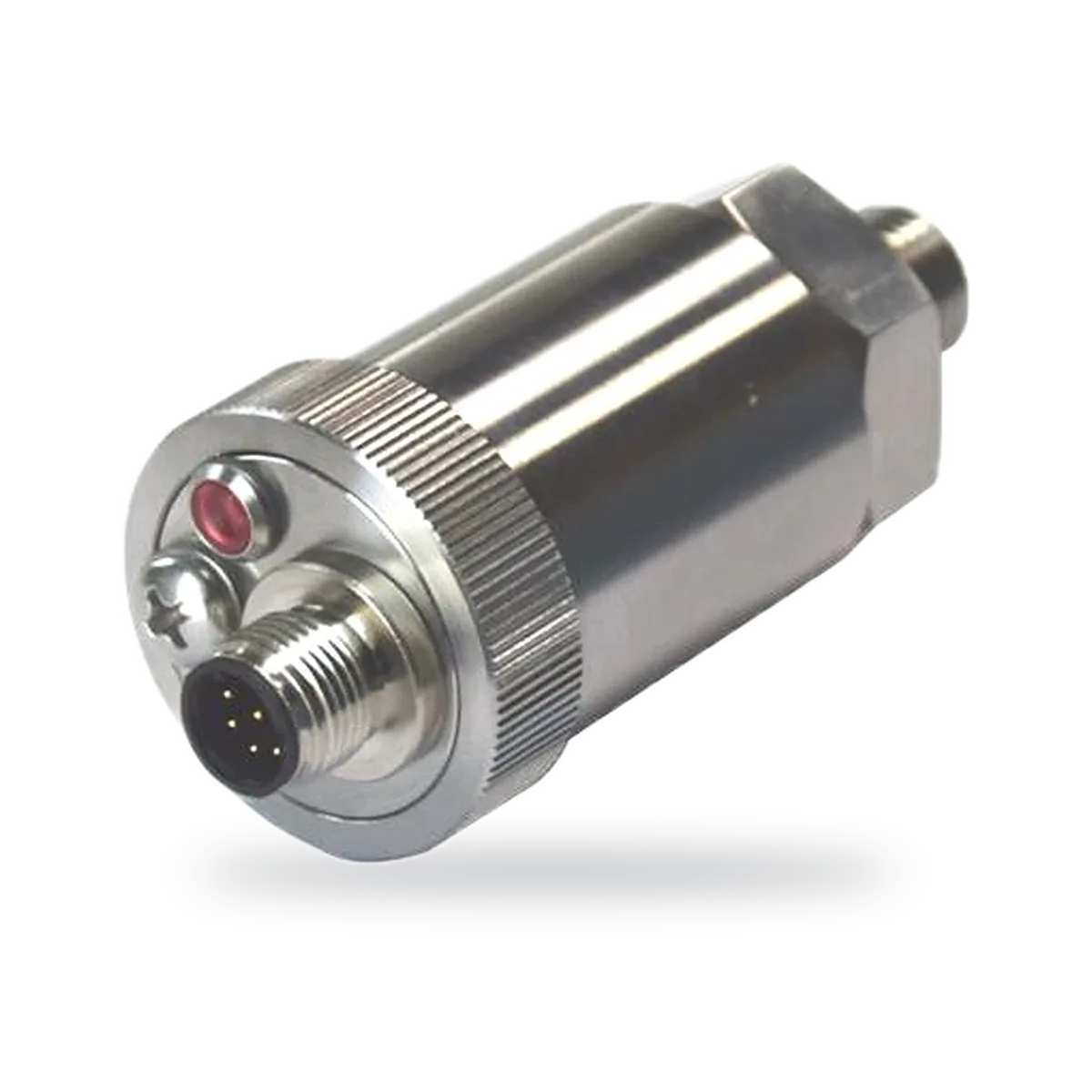
| Display and connection | OLED display, head rotates 330° | M12 8-pin connector |
| Response time | ≤10 ms | ≤10 ms |
| Protection | IP65 | IP65 |
| Process connection | G1/2, G1/4, M20×1.5, NPT1/2, NPT1/4 and others | G1/2, G1/4, M20×1.5, NPT1/2, NPT1/4 and others |
How to set up an electronic pressure switch
- Choose a range so the set point sits in the middle to upper part of it, and the highest pressure, including spikes, stays below the overload rating (≥150% FS on both DWIN switches)
- Set the set point first, then the reset point below it; too small a gap makes the output chatter
- Choose NO or NC so a wiring fault leads to the safe state
- Add a delay if pressure spikes or pump pulsation cause false trips
- Check the load against the relay rating; switch large motors through a contactor
- Test the switch against a reference gauge before putting it into service
Frequently asked questions
What is hysteresis on a pressure switch?
Hysteresis is the difference between the pressure at which the switch turns on (the set point) and the pressure at which it turns back off (the reset point). It stops the output from switching rapidly when pressure hovers near the limit. On an electronic switch you set it by choosing the reset point.
What is the difference between NO and NC on a pressure switch?
A normally open (NO) output is off at low pressure and turns on when pressure rises past the set point. A normally closed (NC) output is on at low pressure and turns off at the set point. Pump control usually uses NC, so the pump runs until pressure is reached.
How do I set a pressure switch for a water pump?
Set the set point at the stop pressure and the reset point at the start pressure, for example 4.0 bar and 3.0 bar, and use the normally closed function to drive the pump contactor. The pump then runs until pressure reaches 4.0 bar and restarts when it falls to 3.0 bar. Leave enough hysteresis to avoid the pump starting too often.
Should I choose a relay or a PNP output?
Choose a relay to switch AC loads, higher currents or a circuit that must be isolated from the sensor supply. Choose a PNP (or NPN) transistor output to connect directly to a PLC input, especially where the output switches often, because transistors do not wear. DWIN's CS-PT623 and CS-PT624 have relay outputs.
Does an electronic pressure switch need power?
Yes. Unlike a mechanical switch, it needs a supply to measure and switch, for example 12 to 30 VDC for DWIN's CS-PT624 and 24 VDC for the CS-PT623. In return it offers adjustable set points, a display and, on some models, an analog output.