PT100 vs NTC temperature sensors: RTD or thermistor, and when to use a transmitter
DWIN Engineering, , 7 min read

A PT100 is a platinum resistance thermometer (RTD) of 100 Ω at 0 °C that rises by about 0.385 Ω per °C, almost linearly, over a wide range. An NTC thermistor falls in resistance as it warms, by roughly 4% per °C near room temperature: far more sensitive, but nonlinear and suited to a narrower range. Choose PT100 or PT1000 for wide ranges and interchangeable accuracy, NTC for low-cost sensing from about −40 to 125 °C.
How does a PT100 work?
A PT100 is a resistance temperature detector (RTD) with a platinum element of 100 Ω at 0 °C. The resistance of platinum rises with temperature in a stable, repeatable way that IEC 60751 defines. The standard curve has a mean coefficient of 0.00385 Ω/Ω/°C between 0 and 100 °C, so a PT100 changes by about 0.385 Ω per °C and reads 138.51 Ω at 100 °C.
Above 0 °C the standard curve is R(t) = R0 (1 + At + Bt²), with A = 3.9083 × 10⁻³ and B = −5.775 × 10⁻⁷. The curve is close to a straight line, so a transmitter can linearize it accurately. A PT1000 follows the same curve at 1,000 Ω, changing by about 3.85 Ω per °C.
PT100 accuracy classes (IEC 60751)
| Class | Tolerance | At 0 °C | At 100 °C |
|---|---|---|---|
| AA | ±(0.1 + 0.0017 |t|) °C | ±0.10 °C | ±0.27 °C |
| A | ±(0.15 + 0.002 |t|) °C | ±0.15 °C | ±0.35 °C |
| B | ±(0.3 + 0.005 |t|) °C | ±0.30 °C | ±0.80 °C |
| C | ±(0.6 + 0.01 |t|) °C | ±0.60 °C | ±1.60 °C |
How does an NTC thermistor work?
An NTC (negative temperature coefficient) thermistor is a ceramic semiconductor whose resistance falls steeply as it warms. It is specified by its resistance at 25 °C (R25) and its B value, which describes the slope of the curve: R(T) = R25 × exp[B (1/T − 1/298.15 K)], with T in kelvin.
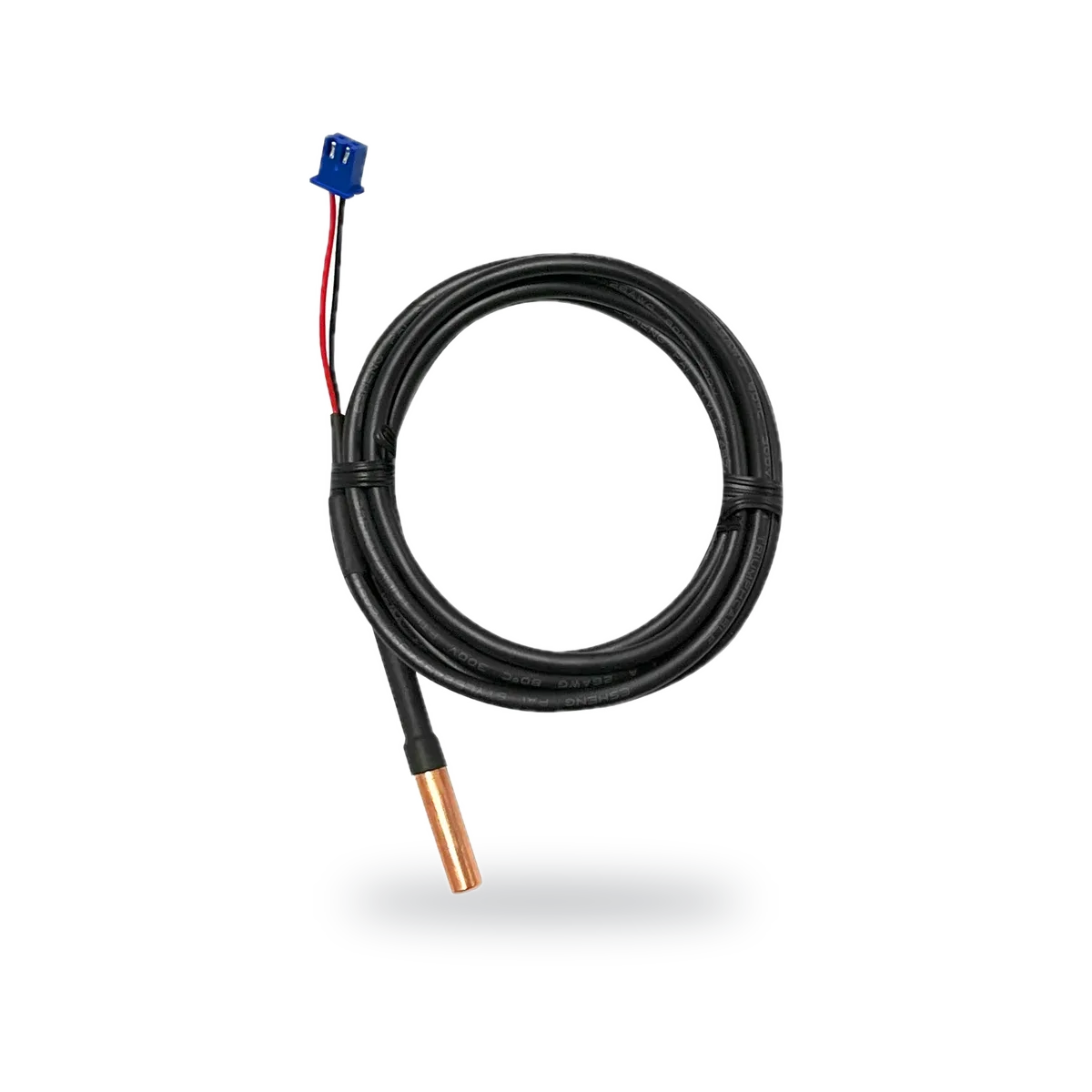
DWIN's CS-TS heat-pump sensor is an example: R25 = 5 kΩ ±1% and B25/50 = 3470 K ±1%. Near 25 °C its resistance changes by about −3.9% per °C, around 195 Ω per °C, against 0.385 Ω per °C for a PT100. That sensitivity makes NTCs easy to read with a simple divider and an ADC, but the curve is strongly nonlinear, so the reading needs a lookup table or the B equation.
PT100 vs PT1000 vs NTC
| PT100 | PT1000 | NTC thermistor | |
|---|---|---|---|
| Resistance | 100 Ω at 0 °C | 1,000 Ω at 0 °C | Set by R25, for example 5 kΩ or 10 kΩ |
| Change with temperature | +0.385 Ω/°C, nearly linear | +3.85 Ω/°C, nearly linear | About −4%/°C near 25 °C, nonlinear |
| Typical range | About −200 to 600 °C, depending on construction | As PT100 | About −40 to 125 °C for most parts |
| Interchangeability | Defined by IEC 60751 classes | As PT100 | Set by R25 and B tolerances |
| Lead-wire error | Large: 3- or 4-wire needed for accuracy | Ten times smaller | Usually negligible |
| Cost | Higher | Higher | Lowest |
| Typical uses | Process plants, labs, wide ranges | Battery and 2-wire circuits, HVAC | Heat pumps, appliances, battery packs |
2-wire, 3-wire or 4-wire RTD?
The measuring instrument sees the RTD plus the resistance of its leads. With a 2-wire PT100, 1 Ω of total lead resistance, which is a cable run of about 15 m in 0.5 mm² copper, reads as 1 ÷ 0.385 ≈ 2.6 °C too warm.
A 3-wire connection measures one lead and subtracts it, assuming both leads are equal, which is the usual choice in industry. A 4-wire connection passes the current through one pair and measures the voltage on the other, so lead resistance drops out entirely, for laboratory and calibration work.
A PT1000 reduces lead error tenfold, so 2-wire wiring is often acceptable over short runs. An NTC with several kilohms of resistance is barely affected by its leads.
Self-heating
The measuring current warms the sensor. The dissipation constant says how much: the CS-TS is 0.9 mW/°C, so 0.9 mW of power raises it 1 °C above its surroundings. Keep the current small. A PT100 is usually read at about 1 mA (0.1 mW at 100 Ω), and an NTC through a divider that keeps its power in the microwatt range.
What does a temperature transmitter do?
A temperature transmitter reads the sensor, linearizes it and outputs a standard signal, usually 4 to 20 mA. The current loop carries the reading hundreds of meters without lead-resistance or noise errors, and a PLC sees a scaled temperature with no RTD input card.
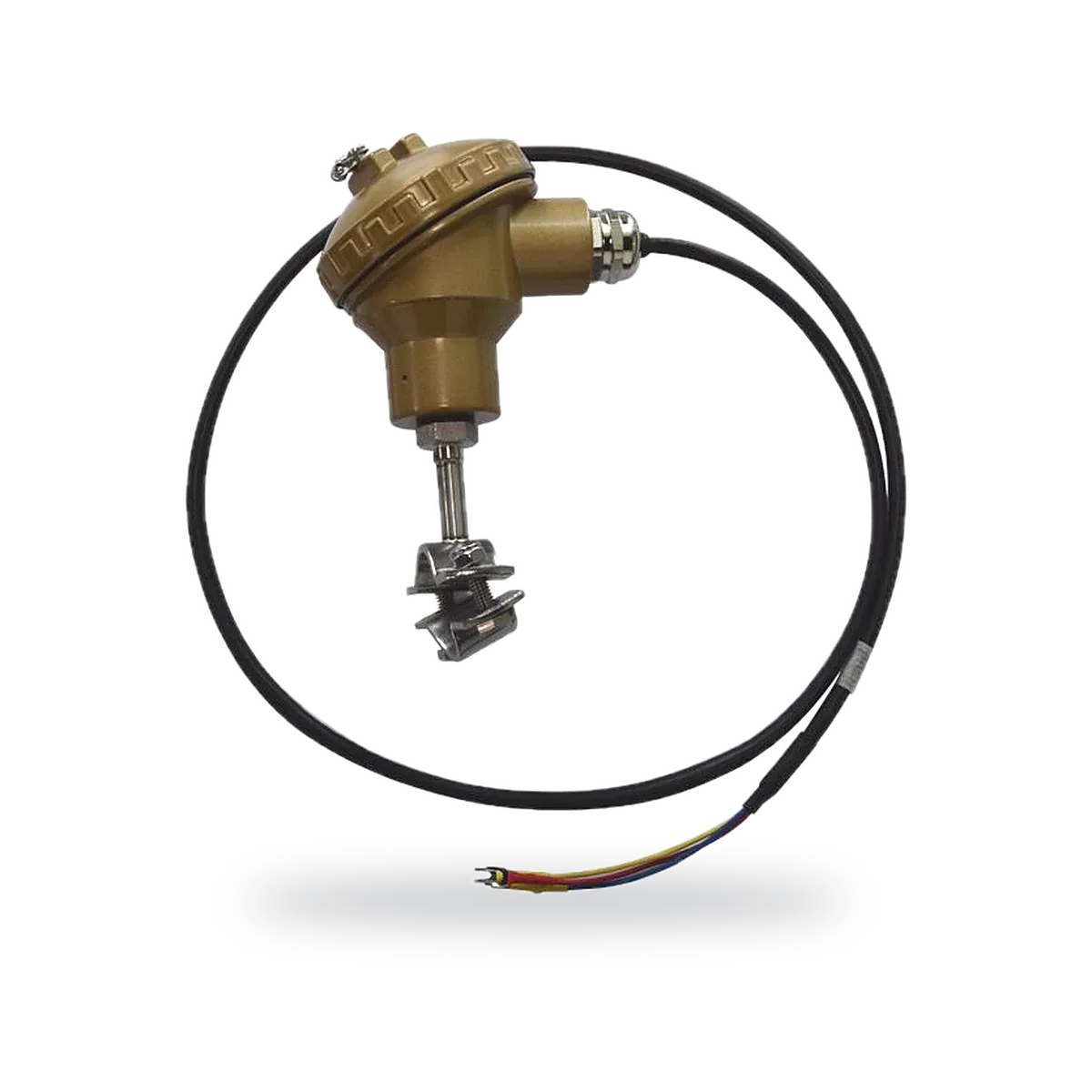
Note the difference between a 3-wire RTD and a 3-wire transmitter: the CS-TT05 has a 3-wire 4 to 20 mA output, meaning supply, ground and signal. It covers −100 to 60 °C at ±2 °C on an 8 to 30 VDC supply, clamped to a 1-inch pipe.
DWIN temperature sensors and transmitters
| Model | Sensing | Range | Output |
|---|---|---|---|
| CS-TS | NTC, R25 = 5 kΩ, B25/50 = 3470 K | −30 to 80 °C operating | Resistance, XH-2Y connector, IP67 |
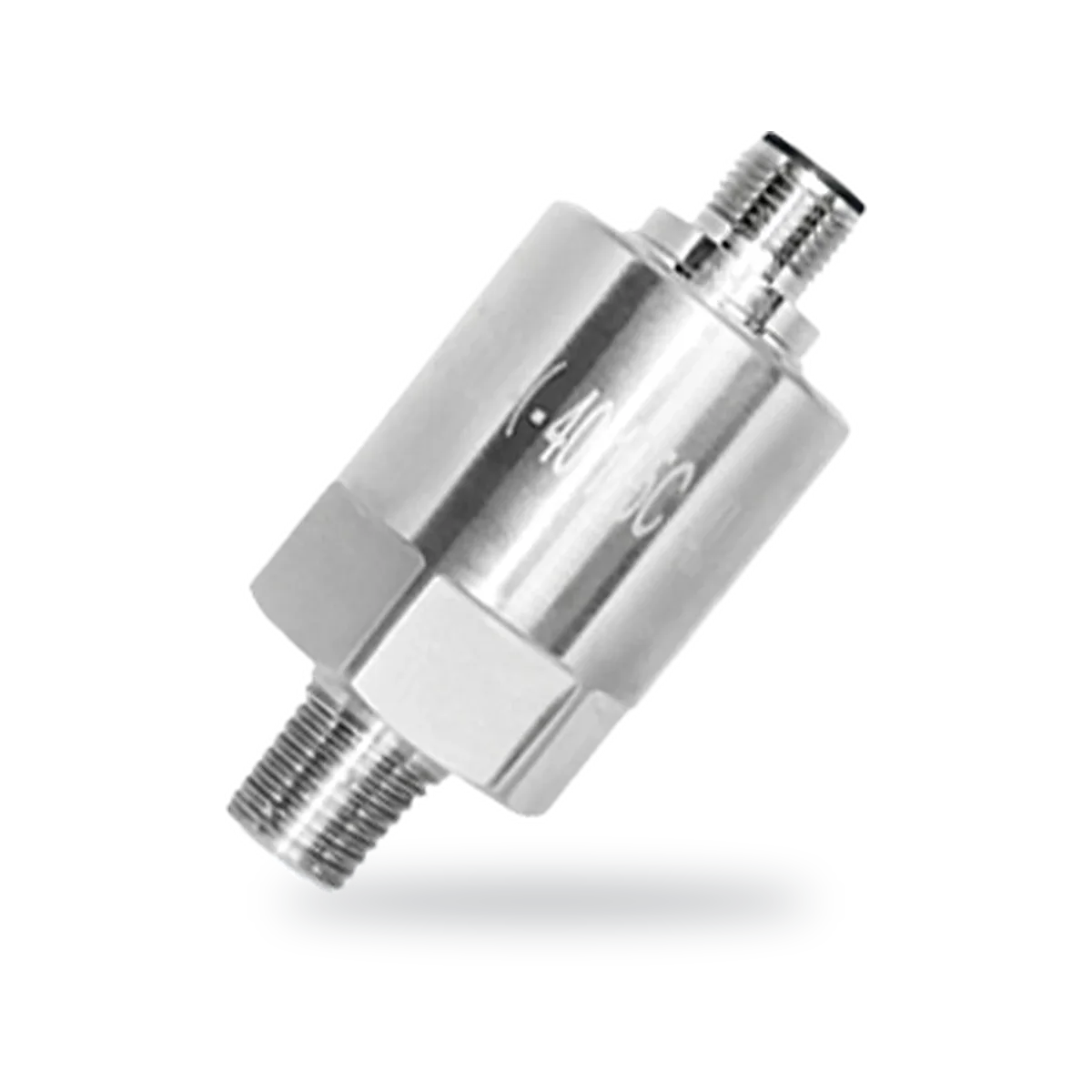
| CS-WPT1200 | NTC, R25 = 10 kΩ, B25/85 = 3435, plus pressure | −40 to 140 °C, 0–150 psi | NTC resistance and 0.5 to 4.5 V pressure |
| CS-WPT1000 | PT1000, plus ceramic pressure core | −40 to 125 °C, 0–5,000 psi | 0.2 to 10.2 V for each, ±1% FS |
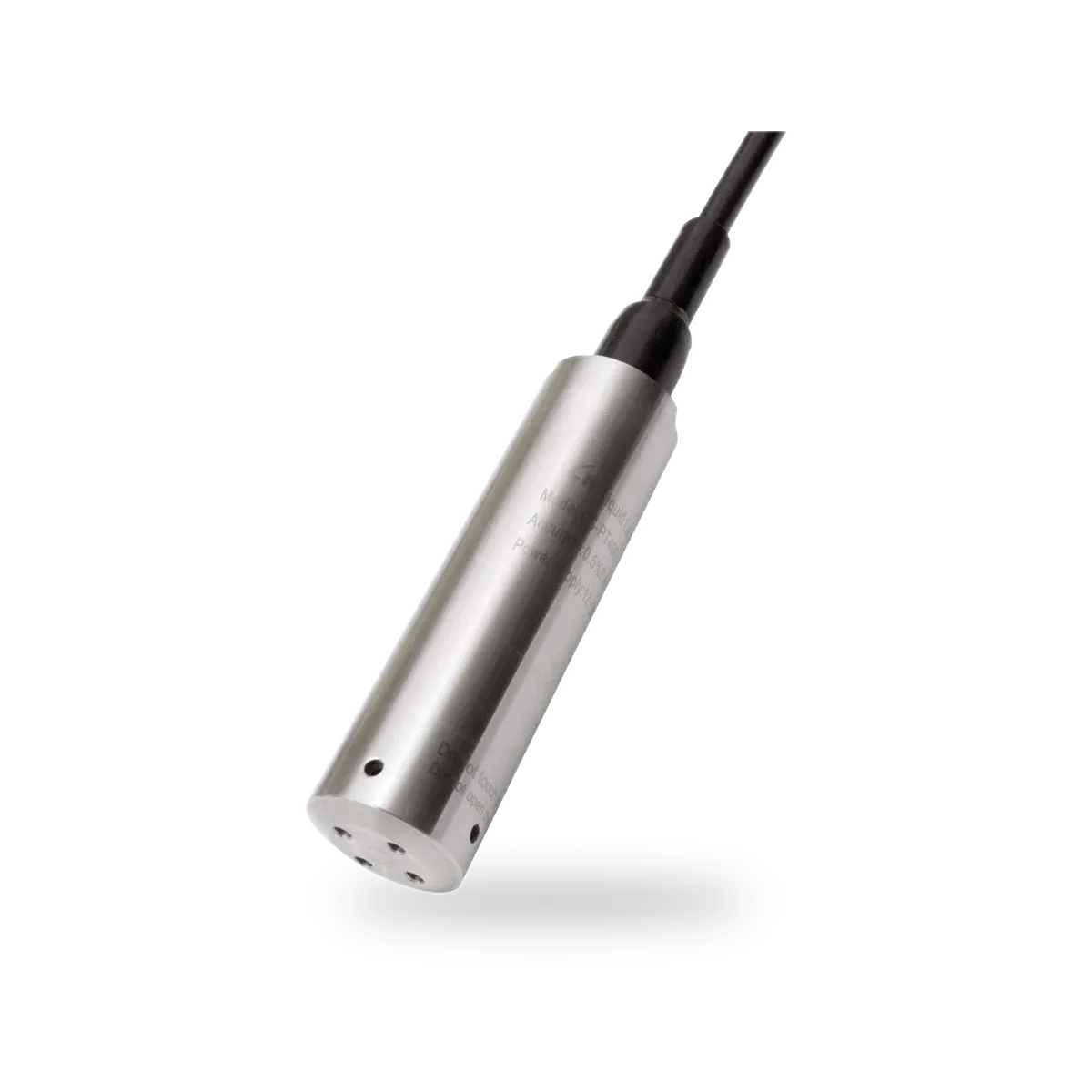
| CS-WPT400 | Platinum sensor, plus level | −40 to 60 °C, 0–3.5 to 0–350 mH2O | 4 to 20 mA for each |
| CS-TT05 | Temperature transmitter | −100 to 60 °C, ±2 °C | 3-wire 4 to 20 mA |
| CS-iWPT302-T | Bluetooth 5.1 transmitter | −40 to 85 °C (−40 to 125 °C non-standard), ±1 °C typical | Wireless, phone app |
How to choose
- Wide range, process plants, or a need for standard interchangeable accuracy: PT100 with a 3-wire connection or a transmitter
- Long cables to a PLC: a 4 to 20 mA temperature transmitter
- Battery-powered or 2-wire circuits where lead error matters: PT1000
- Low cost, high sensitivity between about −40 and 125 °C, such as heat pumps and appliances: NTC
- No cable at all: a wireless transmitter such as the CS-iWPT302-T
- Pressure and temperature at one port: a combined transmitter such as the CS-WPT1000 or CS-WPT1200
Frequently asked questions
What is a PT100 temperature sensor?
A PT100 is a platinum resistance thermometer with a resistance of 100 Ω at 0 °C that rises by about 0.385 Ω per °C. Its curve and tolerance classes are defined by IEC 60751, so sensors from different makers are interchangeable. It is the standard temperature sensor in process industry.
Is PT100 more accurate than NTC?
Over a wide range, yes: a class A PT100 is within ±0.35 °C at 100 °C and stays stable and nearly linear from below 0 to several hundred degrees. A good NTC can be just as precise over a narrow range around its reference temperature, but its tolerance widens away from 25 °C and its curve is nonlinear. For standard interchangeable accuracy, choose a PT100 or PT1000.
What is the difference between PT100 and PT1000?
Both follow the same IEC 60751 platinum curve; a PT1000 simply has ten times the resistance, 1,000 Ω at 0 °C. Its larger signal makes lead-wire resistance ten times less important, so 2-wire connections are often acceptable. The PT100 remains more common in process plants.
What does a temperature transmitter do?
A temperature transmitter converts the signal from an RTD, thermistor or thermocouple into a standard output, usually 4 to 20 mA. It linearizes the sensor curve and lets the reading travel long distances without errors from cable resistance or noise. DWIN's CS-TT05, for example, outputs 3-wire 4 to 20 mA over −100 to 60 °C.
How do I test a PT100 with a multimeter?
Disconnect it and measure resistance across the element: at 0 °C it should read 100 Ω and at room temperature, about 20 °C, roughly 107.8 Ω. An open circuit means a broken element or lead, and near 0 Ω means a short. On a 3-wire sensor the two same-colored leads should read close to 0 Ω between them.