Water level sensor types compared: ultrasonic, submersible, float and capacitive
DWIN Engineering, , 7 min read
The five common water level sensors are ultrasonic sensors that measure from above, external ultrasonic sensors that measure through the tank wall, submersible pressure transmitters that measure from the bottom, float switches and capacitive probes. Choose by whether the sensor may touch the water, whether you need a continuous level or only a high and low alarm, and how the site is powered and connected.
Three questions before you choose
- Continuous level or a point alarm? Ultrasonic and submersible sensors give a value across the range; float switches and many capacitive sensors only say wet or dry at one height
- Contact or no contact? Ultrasonic sensors never touch the water; submersible, float and capacitive sensors sit in it
- Where does the reading go? A local controller, a PLC over 4 to 20 mA or RS485, or a remote server over a wireless network
Ultrasonic from above
A sensor at the top of the tank, well or channel sends a pulse down and times the echo from the water surface. The level is the mounting height minus the measured distance. Nothing touches the water, so dirt, sewage and chemicals do not foul it.
Each sensor has a blind zone just below its face, and the beam must reach the water without hitting ladders, pipes or the wall of a narrow well. Foam absorbs the echo, and heavy condensation on the transducer weakens it. DWIN's A07 reads 25 to 800 cm and the A17 25 to 1,000 cm, both with a 25 cm blind zone, and the A17 has a reference beam angle of about 15° for wells and deep tanks.
External ultrasonic through the tank wall
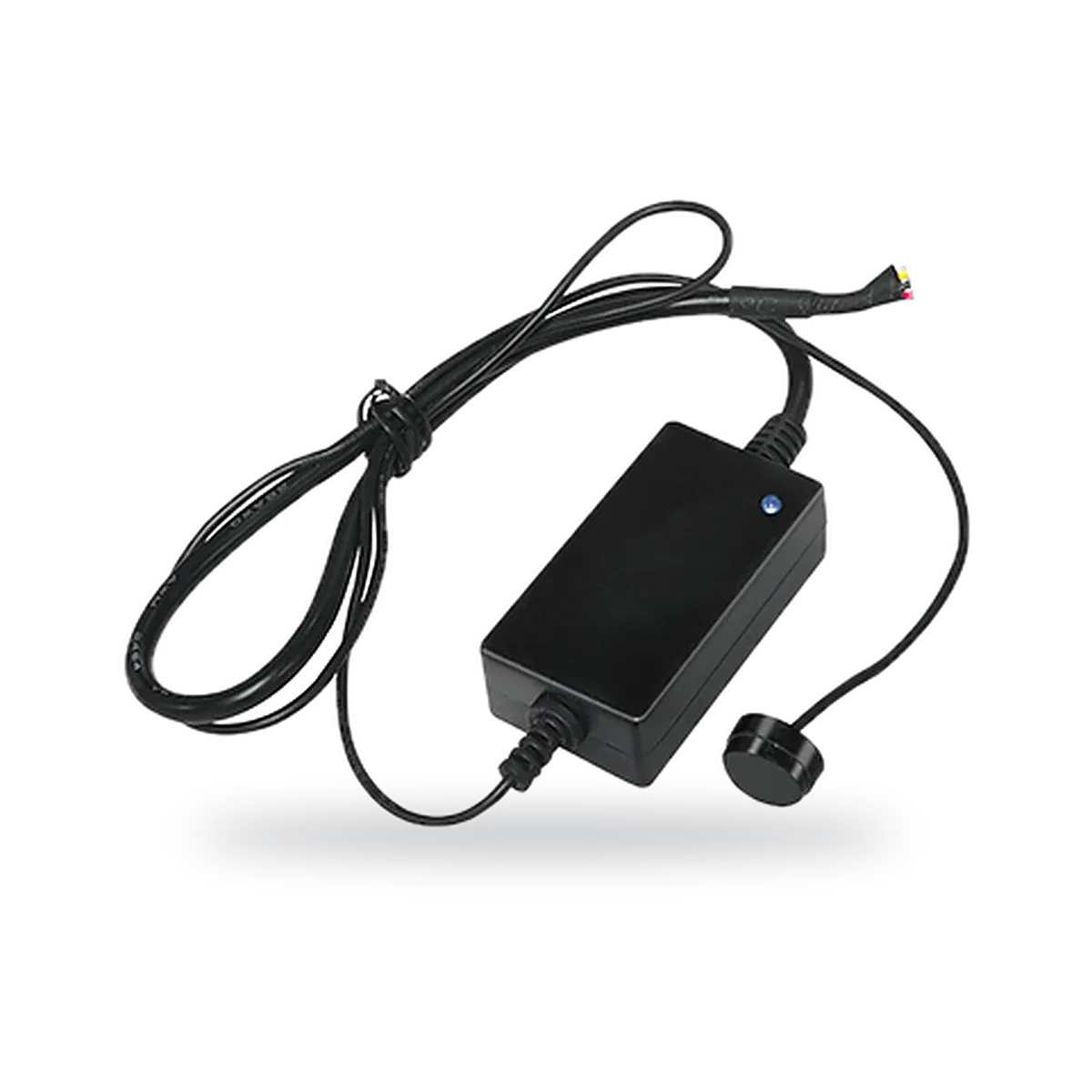
An external sensor sits under the tank bottom and sends ultrasound up through the wall and the water to the surface. The tank is never opened or drilled, which makes it a true non-contact liquid level sensor for sealed and pressurized containers.
The wall must be solid and well coupled to the sensor, and the range is shorter than for sensors in air. DWIN's DS1603 series covers up to 200 cm with an accuracy of ±(5 mm + 1% of distance) on the DS1603DA, the L02 adds a 1 µA standby current for battery devices, and the DS1603NF works as a level switch.
Submersible pressure transmitter
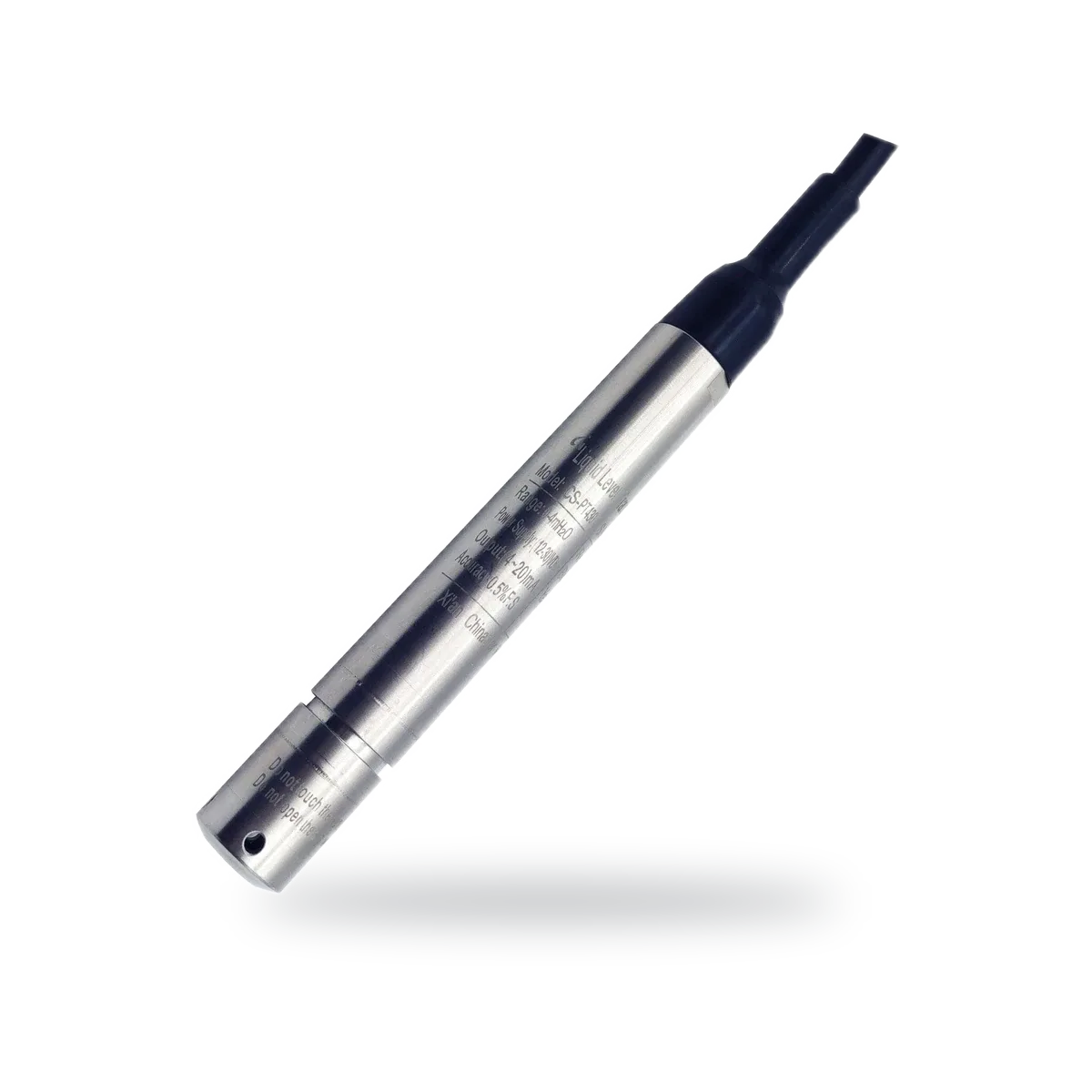
A sealed probe hangs near the bottom and measures the pressure of the water above it; every meter of water adds about 9.81 kPa. Foam, vapor and a crowded tank top do not matter, and the probe fits boreholes too narrow for an ultrasonic beam: DWIN's CS-PT430 is 19 mm in diameter.
The probe touches the water, so sludge and growth must be cleaned off, and the reading depends on density. Gauge versions need a vented cable to cancel changes in air pressure. DWIN's CS-PT400 family covers 0 to 1 m up to 0 to 350 m of water.
Float switches and float sensors
A float rides on the surface and moves a reed switch, a microswitch or a resistor chain. A single float switch is the cheapest high or low alarm and needs no power to switch a pump relay. Floats have moving parts, so debris, scale, ice and turbulence can jam them, and a continuous float sensor gives only stepped readings. DWIN does not make float sensors.
Capacitive level sensors
A capacitive probe measures the change in capacitance as water covers its electrodes. Point versions detect wet or dry through a plastic wall; rod versions give a continuous level along their length. They have no moving parts, but deposits, foam and changes in the liquid shift the reading, and the probe length limits the range. DWIN does not make capacitive level sensors.
At a glance
| Ultrasonic from above | External ultrasonic | Submersible pressure | Float | Capacitive | |
|---|---|---|---|---|---|
| Touches the water | No | No | Yes | Yes | Yes, or through a thin wall |
| Output | Continuous | Continuous or switch | Continuous | Point, or stepped | Point or continuous |
| Upset by | Foam, condensation, obstructions, blind zone | Thick or poorly coupled walls, bubbles | Sludge, density change, blocked vent | Debris, ice, turbulence | Deposits, foam |
| Typical range | Up to about 10 m | Up to about 2 m | Up to hundreds of meters | One height per switch | Length of the probe |
| DWIN examples | A07, A17 | DS1603DA, DS1603NF, L02 | CS-PT400, CS-PT430, CS-PT480 | None | None |
Which water level sensor for wells, tanks, manholes and rivers?
- Deep wells and boreholes: a submersible transmitter, such as the slim CS-PT430; an ultrasonic sensor only if the casing is wide and straight enough for the beam
- Water storage tanks: ultrasonic from above for open tops, external ultrasonic for sealed or plastic tanks you do not want to drill, submersible where foam or vapor block ultrasound
- Pump control with fixed start and stop levels: float switches, or a continuous sensor with two set points
- Manholes and sewers: a battery-powered IoT monitor, such as DWIN's CS-iTWLM, which combines manhole cover and water level monitoring and reports over NB-IoT or CAT.1
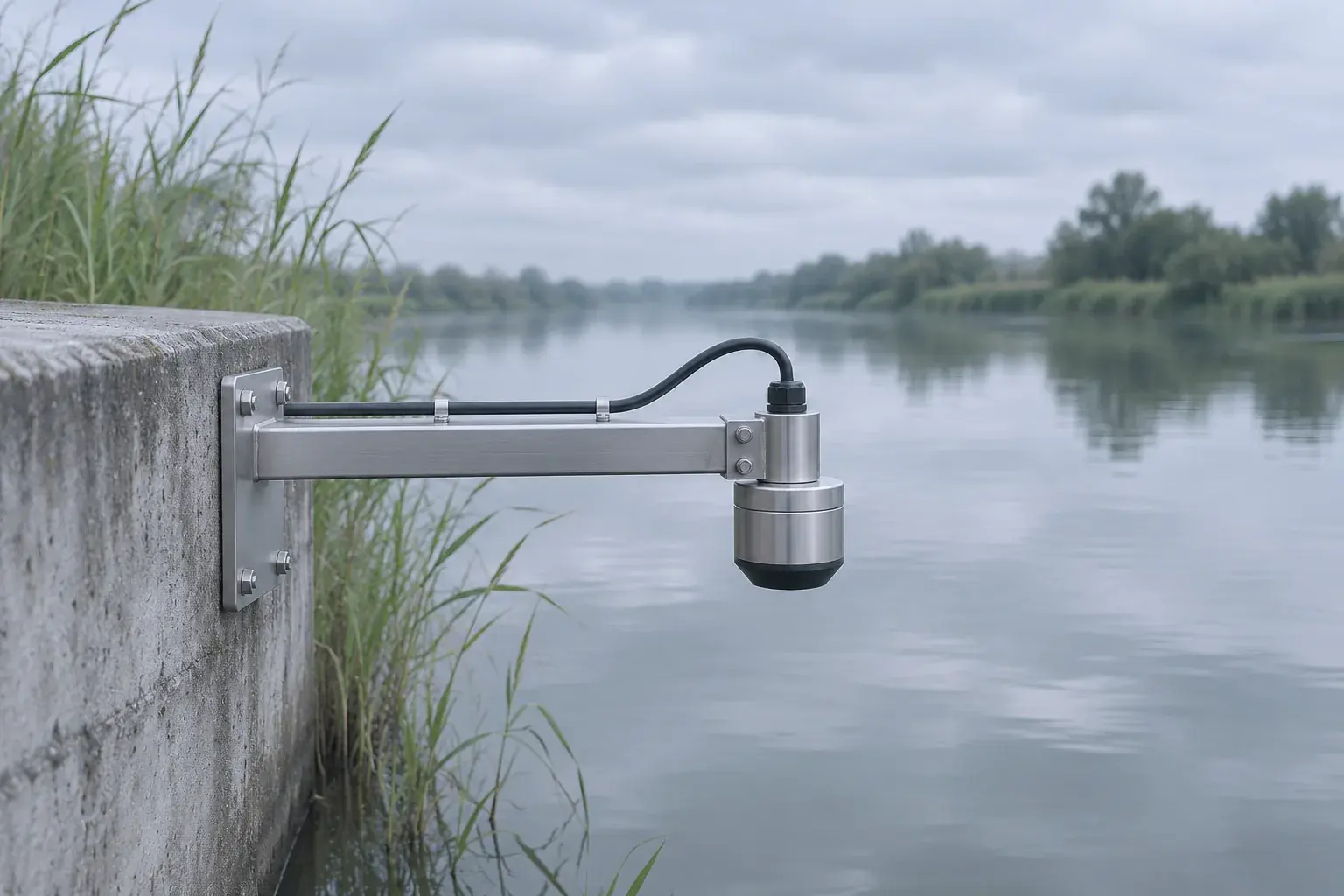
- Rivers, reservoirs and lakes: a submersible transmitter in a stilling pipe, or an ultrasonic sensor on a bridge or bracket above the water
- Remote tanks and ponds without wiring: a wireless level terminal such as the CS-iTLLS-05, which measures by pressure and reports over LoRaWAN, NB-IoT or GSM/GPRS
Frequently asked questions
What is the most accurate water level sensor?
For deep water, a good submersible pressure transmitter is usually the most accurate continuous sensor: DWIN's CS-PT400 is ±0.25% of full scale in its better grade, which is ±2.5 cm on a 10 m range. For short ranges, ultrasonic sensors are often better in absolute terms: the A17 is specified at ±(1 cm + 0.3% of distance). Real accuracy also depends on installation, density and temperature.
What is a non-contact liquid level sensor?
A non-contact liquid level sensor measures level without touching the liquid. Ultrasonic sensors mounted above the surface and external ultrasonic sensors that measure through the tank bottom are the common types; radar level sensors are another. They suit dirty, corrosive or sealed contents where a probe would foul or must not enter.
What is the best sensor for a water tank?
For an open-top tank, an ultrasonic sensor mounted above the water is simple and never touches it. For a sealed or plastic tank you do not want to drill, an external ultrasonic sensor under the tank bottom works through the wall. If the tank has foam, heavy condensation or a crowded top, a submersible pressure transmitter is more reliable.
How do you measure the water level in a well?
Lower a submersible pressure transmitter on its cable to below the lowest expected water level and read the pressure as water depth above the probe. Subtract that depth from the probe depth to get the depth to water, if that is what you need. In wide, straight wells an ultrasonic sensor at the top, such as DWIN's A07 or A17, can measure the distance down to the water instead.
Can a water level sensor send data to a phone or the cloud?
Yes, if it is connected to a wireless terminal or gateway. Battery-powered IoT terminals such as DWIN's CS-iTLLS-05 report level over LoRaWAN, NB-IoT or GSM/GPRS to a server, where an app or dashboard shows the level and raises alarms. Wired sensors with RS485 or 4 to 20 mA outputs can be connected to a telemetry unit that does the same.
Ultrasonic level sensors, Pressure and level transmitters, IoT monitoring